

FedEx 2026 Peak Season Surcharges: What Shippers Need to Know
FedEx has announced its 2026 holiday Demand Surcharges—formerly called peak surcharges—for U.S. domestic package services. The new fees begin as early as September 28, 2026, expand to residential, express, and Ground Economy shipments on October 26, peak during the core holiday window of November 23 through December 27, and end January 17, 2027.
For many shippers, the issue is not one surcharge in isolation. These charges stack on top of base transportation rates, fuel, residential fees, delivery-area surcharges, additional-handling fees, and other accessorials. That means the all-in impact can be materially larger than the advertised per-package amount.

Core Holiday Charges
The largest broadly applicable increase is the core-holiday residential demand surcharge: $0.80 per qualifying package from November 23 through December 27. For a shipper tendering 100,000 residential Ground or Home Delivery packages in that five-week period, that charge alone equals $80,000, before considering existing residential, delivery-area, fuel, or other accessorial charges.
The Hidden Exposure: Enterprise Residential Demand
FedEx also maintains a separate, volume-triggered Demand—Residential Delivery Charge for enterprise customers shipping more than 20,000 combined U.S. domestic residential and Ground Economy packages in a calculation week. It is assessed in addition to the standard residential delivery charge, and contracted discounts or caps on the standard residential charge do not apply to it.
The charge is based on a shipper’s weekly volume relative to its June 1–28, 2026 baseline, with a two-week lag between the calculation week and billing week. For Ground and Home Delivery, the added fee ranges from $1.70 per package when volume exceeds 105% of baseline to $8.00 per package when it exceeds 400%; eligible express services range from $3.05 to $9.35 per package.
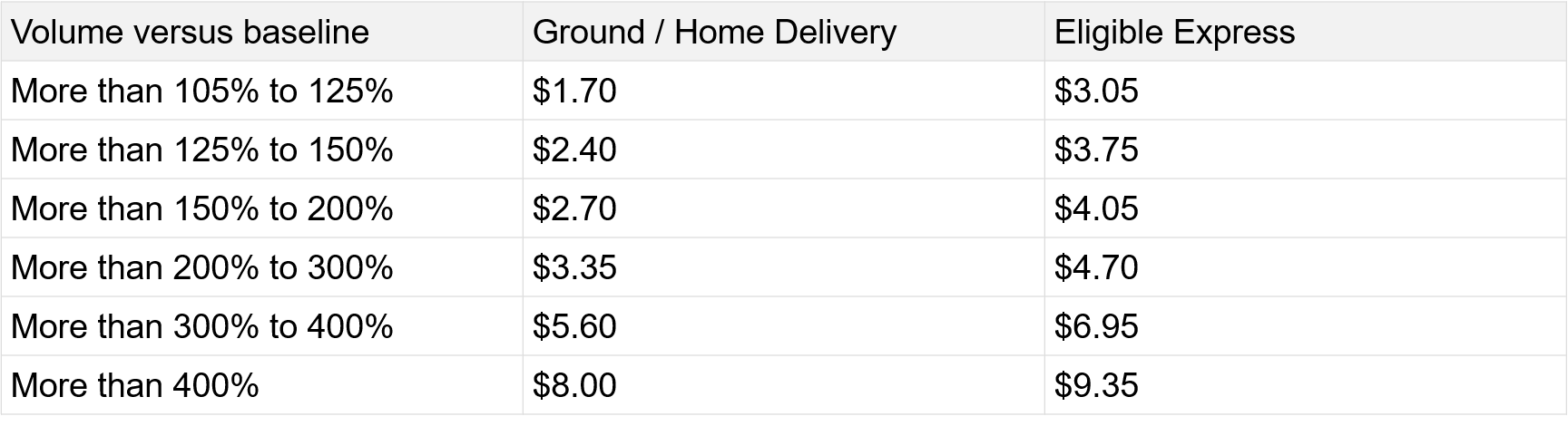
These fees apply on top of the standard holiday demand surcharge. A high-volume residential shipper should therefore evaluate both its per-package holiday charges and its potential exposure to the enterprise residential volume trigger.
Shipper Impact
E-commerce and residential-heavy shippers should model the $0.50 to $0.80 per-package charge across holiday volume, then test whether weekly volume spikes could trigger the additional enterprise residential fee.
Bulky, heavy, or dimensionally inefficient shippers face the sharpest dollar exposure. A single oversize package will carry a $117.25 demand charge during the core holiday period, while a Ground unauthorized package will carry a $595 charge.
Express-dependent shippers should evaluate whether service-level changes, order cutoff adjustments, or earlier fulfillment can reduce late-season air volume. The peak demand charge reaches $2.55 for overnight and $2.35 for 2Day/Express Saver packages.
International shippers should monitor the separate international program closely. FedEx states that it will adjust U.S. international demand surcharges and apply non-standard shipment fees to international package shipments effective September 21, with further holiday details expected in early September.
What To Do Now
Model your shipment file. Apply each surcharge period to forecasted September–January volume by service, residential status, package characteristics, and weekly volume.
Separate controllable from contractual cost. Identify packages triggering Additional Handling, Oversize, or Unauthorized Package charges; packaging, order-routing, and service selection may offer immediate mitigation.
Check contract language. Confirm which demand surcharges are discounted, capped, excluded, or passed through at full value. Pay particular attention to residential delivery-charge provisions, since FedEx specifies that contracted discounts and caps do not apply to its enterprise demand-residential charge.
Create a peak operating plan. Align fulfillment, customer-service promises, carrier capacity, and alternative-carrier options before the high-cost window begins—not after invoices arrive.
Get a Peak-Impact Review
Peak surcharges are not merely a seasonal inconvenience; they are a measurable margin event. ShipTrim can model FedEx’s 2026 demand surcharges against your actual shipment profile, quantify exposure by service and package type, identify contract offsets, and evaluate practical carrier or operational alternatives.
Contact ShipTrim for a no-cost parcel contract and peak-impact assessment before holiday charges begin.
