

UPS Announces 2026 Demand Surcharges: What Parcel Shippers Need to Know
UPS has announced its 2026 Demand Surcharge program, bringing another layer of peak-season cost pressure to domestic, residential, air, oversized, and certain international shipments. For many shippers, the important issue is not simply that a surcharge exists—it is how the dates, package characteristics, service mix, and volume thresholds interact with the pricing already built into their UPS agreement.
The 2026 program begins as early as September 27, 2026, adds broader package-level demand surcharges beginning October 25, reaches its highest levels during the holiday peak, and remains in effect through January 16, 2027.
The 2026 UPS Demand Surcharge schedule
UPS has separated its 2026 peak pricing into several categories. The charges below are incremental fees that can apply on top of contracted transportation rates, fuel, residential charges, delivery-area charges, additional handling, and other applicable accessorials.
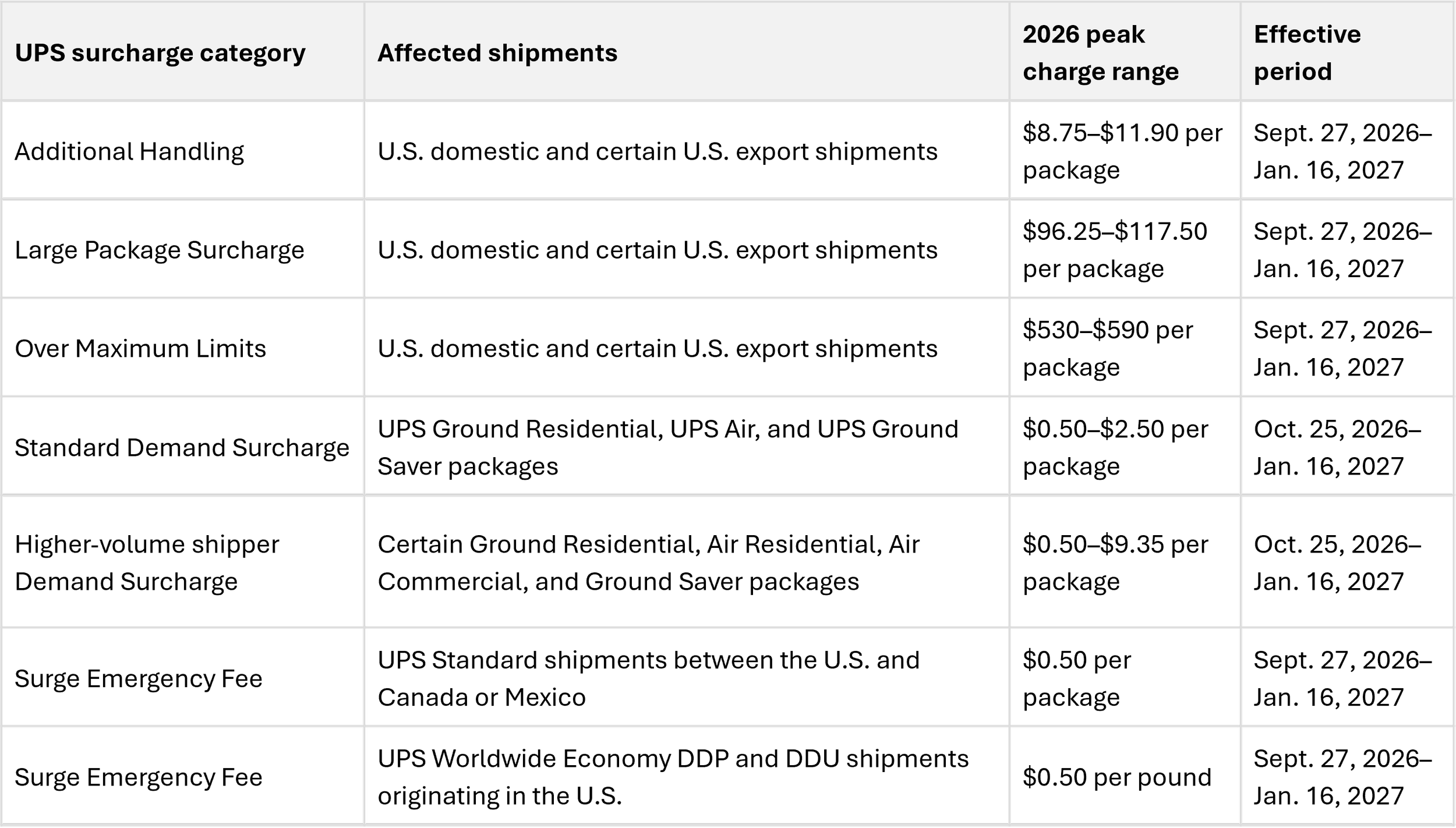
UPS also states that its updated Demand Surcharge information includes rates for certain domestic shipments effective September 27, while revised Surge Emergency Fees apply to relevant U.S. imports and exports starting the same date.
The key distinction: standard versus high-volume demand fees
Not every shipper will be treated the same way.
UPS has a standard demand surcharge for eligible Air, Ground Residential, and Ground Saver packages. However, customers that are billed for more than 20,000 packages in any week following October 2025 may instead be subject to a separate, higher-volume demand surcharge structure. That charge is tied to how a customer’s shipping volume deviates from its defined UPS baseline.
This is where many organizations can get caught off guard.
A shipper may assume that its peak cost is a flat seasonal amount—perhaps $0.50 to $2.50 per package—only to find that its peak volume behavior, customer demand, or baseline calculation places it in a materially different pricing category. Under the high-volume program, demand surcharges can reach as high as $9.35 per package during the designated peak period.
For CFOs and logistics leaders, the question is not only, “What is our contracted UPS discount?” It is also:
“What will our total cost per shipment become when peak volume, package characteristics, accessorials, and dynamic demand fees are applied together?”
Why the impact can be larger than it looks
The flat package-level fee can seem manageable when viewed in isolation. But parcel cost is cumulative.
Consider a residential package that already has a transportation charge, a fuel surcharge, a residential delivery charge, and possibly an additional handling fee. The 2026 UPS Demand Surcharge is another layer on that shipment—not a replacement for the other cost components.
The highest exposure typically falls on shippers with one or more of these traits:
Heavy residential delivery volume through UPS Ground Residential, Air, or Ground Saver
Meaningful November and December shipment growth
Large, awkward, dimensional-weight-sensitive, or non-conveyable packages
A high concentration of additional handling or large-package shipments
U.S. cross-border Standard volume to Canada or Mexico
U.S.-origin UPS Worldwide Economy DDP or DDU volume
A prior or expected weekly volume profile that may trigger the higher-volume surcharge structure
The size-related fees deserve particular attention. A $96.25–$117.50 Large Package Surcharge or a $530–$590 Over Maximum Limits charge can overwhelm even a strong base-rate discount on a single package.
The holiday window is not one rate
UPS’s 2026 fees are not simply “holiday charges” that apply uniformly from Thanksgiving through Christmas. The program has multiple start dates, rate tiers, and affected services.
September 27, 2026: Additional Handling, Large Package, Over Maximum Limits, and certain international Surge Emergency Fees begin.
October 25, 2026: Demand Surcharges begin for qualifying Air, Ground Residential, and Ground Saver shipments.
November 22 through December 26, 2026: The charges reach their highest levels during the core holiday-demand period.
January 16, 2027: The current 2026–27 peak surcharge program ends.
That timing matters for budgeting. A shipper that models only Black Friday through Christmas may understate exposure from late September, October, and the first half of January.
2026 versus 2025
Initial industry analysis indicates that UPS increased certain 2026 peak fees meaningfully compared with 2025:
Additional Handling and size-related demand charges increased by approximately 6% to 10%.
Flat service-level demand charges increased by approximately 22% to 25%.
UPS expects U.S. volume to rise approximately 24% from the third quarter to the fourth quarter of 2026, which helps explain why the carrier is again using seasonal pricing tools to manage peak network demand.
The broader lesson is that annual base-rate discounts do not insulate a shipper from midyear or seasonal carrier pricing changes. Peak fees, fuel, accessorial revisions, minimum charges, and operational changes can all alter realized savings after a contract is signed.
What shippers should do now
1. Model the actual exposure
Use your own shipment data—ideally the last peak season plus current-year volume—to calculate the impact by:
Service level
Residential versus commercial delivery
Package dimensions and weight
Additional Handling and Large Package incidence
Weekly package volume
International lane and service
Projected peak-season order growth
Do not rely on an average package cost. The cost impact is often concentrated in certain segments of the network.
2. Validate your UPS volume baseline
If your organization may exceed the 20,000-package weekly threshold, review the applicable UPS baseline methodology and determine whether you could fall into the higher-volume demand surcharge program.
This is especially important for e-commerce retailers, subscription businesses, marketplaces, and companies planning promotions that create a sharp week-over-week volume spike.
3. Review your contract—not just the rate card
Look for the treatment of:
Peak or Demand Surcharge exclusions
Additional Handling and Large Package incentives
Residential surcharge discounts
Ground Saver pricing and usage rules
Minimum-package-charge exposure
International service pricing
Contract language that permits carrier-published surcharge changes to flow through automatically
A large base-rate discount does not necessarily offset a surcharge that is excluded from discounting or that is applied after other rating components are calculated.
4. Adjust operational decisions early
Peak fees are not just a procurement issue. They can influence:
Free-shipping thresholds
Customer cutoff dates
Delivery promise language
Packaging design and cartonization
Fulfillment-center allocation
Carrier-service selection
Promotions that create avoidable volume spikes
Cross-border shipping alternatives
The earlier these decisions are made, the more options exist to reduce the cost impact without sacrificing the customer experience.
5. Build parcel oversight into your financial controls
A parcel contract should not be treated as a one-time negotiation event. The savings that matter are the savings that remain visible on invoices and in the P&L after carriers apply seasonal fees, GRIs, changing rules, and accessorial charges.
Monthly oversight should track a small, useful set of measures:
Effective net discount by service
Total accessorial spend as a percentage of parcel spend
Residential and delivery-area surcharge exposure
Additional Handling and Large Package frequency
Cost per shipment by customer segment or fulfillment center
Weekly volume against applicable carrier baselines
Peak surcharge dollars by service and package type
The ShipTrim perspective
For shippers spending $100,000 to $5 million annually on parcel, the UPS 2026 Demand Surcharge announcement is a practical reminder that transportation cost management does not end when the contract is signed.
ShipTrim helps companies audit UPS and FedEx invoices, identify billing leakage and surcharge exposure, and evaluate whether their contract terms are keeping pace with their actual shipping profile. During a 30-day free parcel audit, we can help quantify where peak and accessorial costs are landing, identify recoverable invoice issues, and use the shipment data to assess larger contract opportunities.
The audit finds the immediate leakage. The contract analysis identifies the structural opportunity.
If UPS is a meaningful part of your peak-season shipping plan, now is the time to model your 2026 Demand Surcharge exposure—before the charges begin appearing on your invoices.
