

FedEx Announces 2027 GRI: Why the 5.9% Headline Is Not Your True Parcel Cost Increase
FedEx has announced its 2027 General Rate Increase, effective January 4, 2027. The company states that standard list rates for U.S. package, U.S. export, and U.S. import services will increase an average of 5.9%.
That is the number most shippers will see in the headline. It is also not necessarily the number that will show up in their parcel budget.
The 5.9% figure reflects an average change in published transportation rates. Your actual increase will depend on your shipment profile, including service mix, zones, weights, residential volume, package dimensions, minimum charges, and accessorial exposure.
For CFOs and logistics leaders, the better question is:
What will FedEx’s 2027 changes do to our true cost per shipment and total parcel spend?
Answering that requires more than applying 5.9% to last year’s FedEx spend.
The 5.9% GRI is a starting point
A General Rate Increase is not a flat 5.9% adjustment applied equally to every shipment.
FedEx changes rates differently across services, zones, weights, package types, and surcharge categories. Some shipments may experience a lower increase. Others may rise well above the published average.
Industry analysis indicates that five of FedEx’s seven major services are expected to increase by more than 5.9%, including FedEx First Overnight at 6.01% and FedEx 2Day A.M. at 6.65%. Ground and Home Delivery rate changes also average about 6.1% across Zones 2 through 8.
The bigger issue is that transportation charges are only one component of the final invoice.
A typical FedEx invoice can include:
Transportation charges
Fuel surcharge
Residential Delivery Charge
Delivery Area Surcharge
Extended Delivery Area Surcharge
Additional Handling charges
Declared Value charges
Dimensional weight impact
Minimum package charges
Address correction and other exception fees
Seasonal Demand Surcharges, when applicable
When those accessorial categories rise faster than base transportation rates, the 5.9% headline can significantly understate the real budget impact.
Accessorial costs are increasing faster
FedEx’s 2027 accessorial changes tell a more complete story. Several recurring parcel fees are increasing at rates above the 5.9% average GRI.
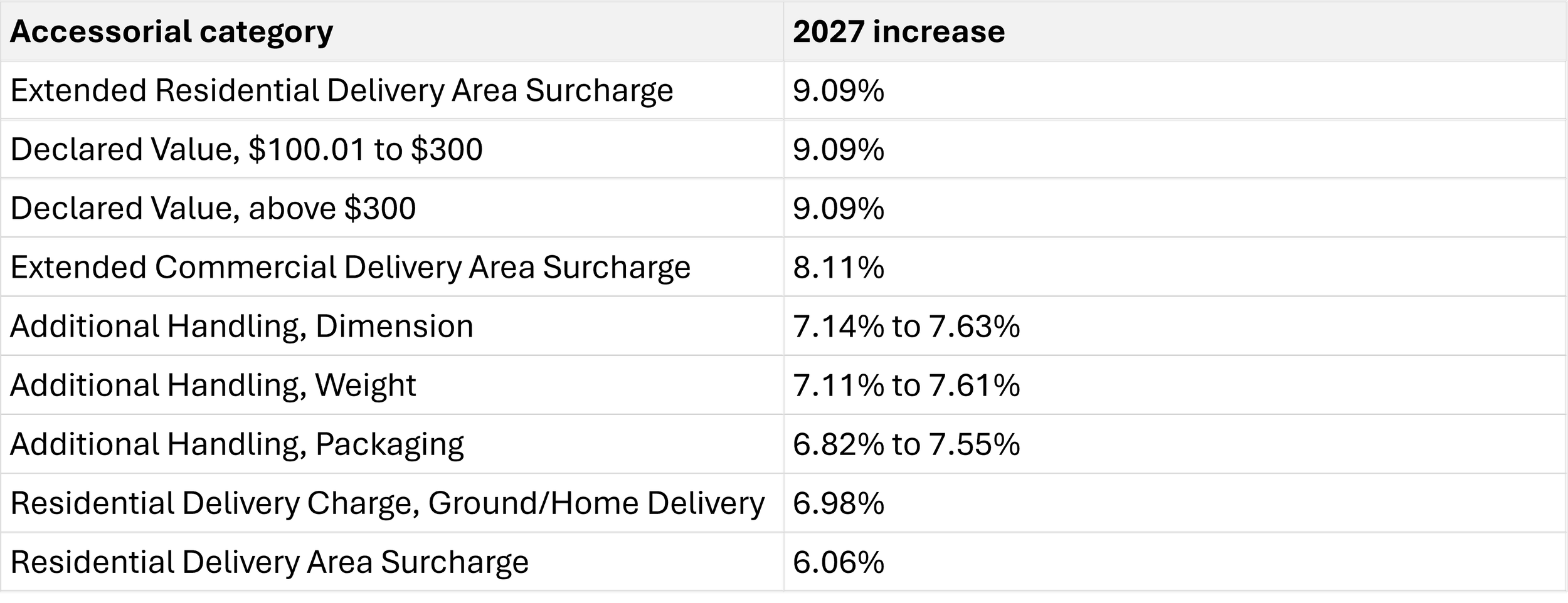
FedEx’s official 2027 rate update confirms that package rates, minimum charges, surcharges, and fees are changing on January 4, 2027.
For shippers with meaningful residential delivery, rural delivery, high-value products, bulky packages, or Additional Handling exposure, the real cost increase can be materially higher than 5.9%.
Who is most exposed?
The greatest exposure is likely to fall on shippers with one or more of the following characteristics:
E-commerce businesses with a large residential delivery mix
Companies serving remote, rural, or extended delivery areas
Shippers that insure or declare value on high-value merchandise
Businesses shipping long, bulky, irregular, or heavy packages
Operations with frequent Additional Handling charges
Companies with rising dimensional-weight exposure
Shippers with low-weight Ground packages subject to increasing minimum charges
Businesses that have not reviewed invoice-level surcharge spending recently
Extended Residential Delivery Area Surcharges are increasing from $8.80 to $9.60, or 9.1%. Additional Handling charges are moving up about 7% to 7.6%, depending on the trigger and shipment type.
These charges can quickly change the economics of a shipment, particularly where carrier agreements offer limited discounts or no discount protection on accessorials.
A simple example
Consider a hypothetical residential shipment with the following charges:
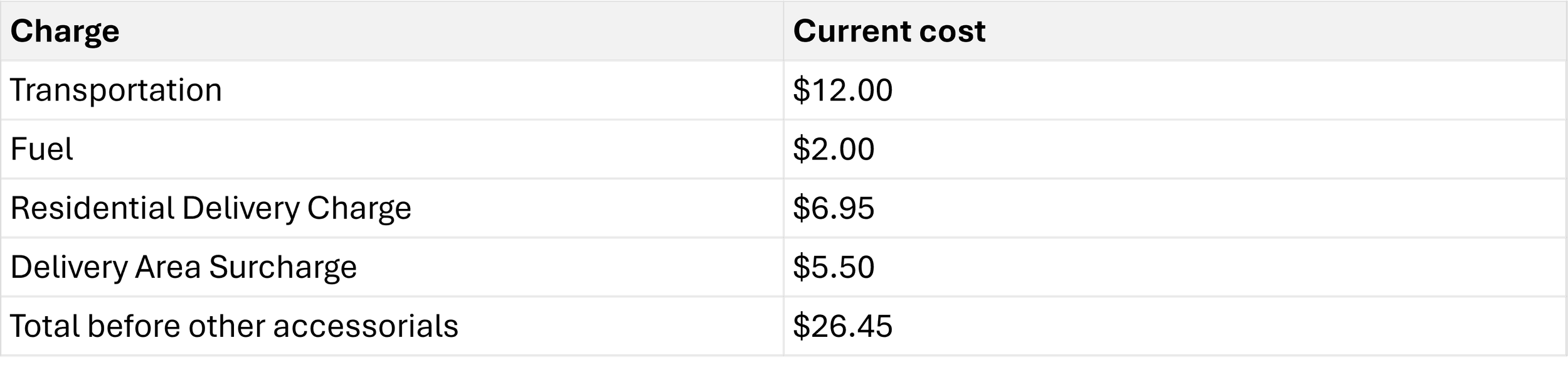
A 5.9% transportation increase adds about $0.71 to the base transportation charge.
However, the residential and Delivery Area components may increase at 6% to 9% or more. If the package also triggers dimensional weight, Additional Handling, Declared Value, or a peak demand fee, the total invoice impact can exceed the simple 5.9% estimate by a meaningful amount.
This is why companies should not budget for 2027 by multiplying their total FedEx spend by 5.9%.
The correct approach is to model the increase at the invoice level using the services and surcharge categories that actually make up your spend.
Why contract discounts may not protect you
A FedEx agreement may show strong base transportation discounts while still leaving a shipper exposed to rising accessorial charges.
This happens when:
Accessorials receive limited discounts
Certain charges are excluded from discounts
Carrier-published fees flow through automatically
Minimum charges override the value of negotiated discounts
The business’s shipping profile changes after the agreement is signed
Residential, delivery-area, DIM, or Additional Handling exposure increases over time
A contract should not be measured solely by its stated discounts. It should be measured by its realized net cost on invoices.
The 2027 GRI is a reminder that a parcel agreement needs regular oversight. Savings can erode through base-rate changes, accessorial increases, minimum charges, fuel, seasonal surcharges, and changes in package profile.
What shippers should do before January 4
1. Model the actual impact
Separate current FedEx spend into the cost categories that make up your invoices:
Transportation by service, zone, and weight
Fuel surcharge
Residential delivery charges
Delivery Area and Extended Delivery Area Surcharges
Additional Handling by trigger type
Declared Value
Minimum package charges
Dimensional-weight-related cost
Other recurring accessorials
Then apply the new published rates and fees to each category.
2. Identify the fastest-growing cost areas
Do not focus only on average package cost. Look for cost categories with the highest rate increase and the largest share of total spend.
Pay close attention to:
Residential delivery
Extended delivery areas
Additional Handling
Oversize or irregular packages
High-value shipments
Ground minimum charges
DIM-weight exposure
Customer segments that create exception costs
3. Review contract protection
Review your FedEx contract with these questions in mind:
Which accessorials are discounted?
Do the discounts apply to the current published charge?
Are there caps, fixed rates, or other protections?
Does the contract address the charges driving your current spend?
Does your agreement reflect your business today, or the profile you had when the contract was signed?
4. Use the GRI as an operating decision point
The 2027 GRI should trigger a review of more than carrier pricing.
It is also a reason to reassess:
Packaging and cartonization
Service selection
Carrier allocation
Fulfillment-center strategy
Zone-skipping opportunities
Customer shipping policies
Free-shipping thresholds
Address-quality controls
Carrier contract terms
The goal is not simply to accept the annual rate increase. The goal is to understand the actual financial exposure and reduce the avoidable portion before it reaches the P&L.
The ShipTrim perspective
FedEx’s 5.9% average GRI is real. It is also only the headline.
The deeper story is found in the service-level rate changes, minimum charges, and accessorial increases. Extended Residential Delivery Area and Declared Value charges are increasing 9.09%. Extended Commercial Delivery Area charges are increasing 8.11%. Additional Handling increases range from 6.82% to 7.63%.
For many shippers, those increases will matter more than the published average.
ShipTrim helps companies move beyond carrier headlines. We analyze actual shipment and invoice data to model GRI impact, identify surcharge exposure, review contract protection, and advise on practical actions that can protect margin.
Let ShipTrim review and advise on your 2027 FedEx GRI impact before the new rates begin appearing on your invoices.
