

UPS Year-End and 2027 Rate Changes: Why Your Parcel Budget Needs More Than a Headline Percentage
UPS has published several pricing updates that shippers should review before finalizing their 2027 transportation budgets. The changes include a November fuel surcharge adjustment and a December update to the UPS Small Business Rates program that combines higher shipping rates, a separate fuel surcharge, and a higher minimum billable weight for Additional Handling packages.
These changes do not all apply to the same customers. That distinction matters.
A shipper using UPS Small Business Rates should not assume its announcement applies to a negotiated Daily Rates agreement. Likewise, a company with a negotiated UPS contract should not assume that a strong transportation discount protects it from fuel changes or seasonal fees.
For finance and logistics leaders, the question is straightforward:
What will these changes do to the cost of the shipments we actually send?
The answer starts with identifying your pricing program, reviewing your contract, and separating permanent rate changes from temporary demand charges.
What UPS has announced
The following summarizes the confirmed changes in the UPS announcements reviewed for this article.
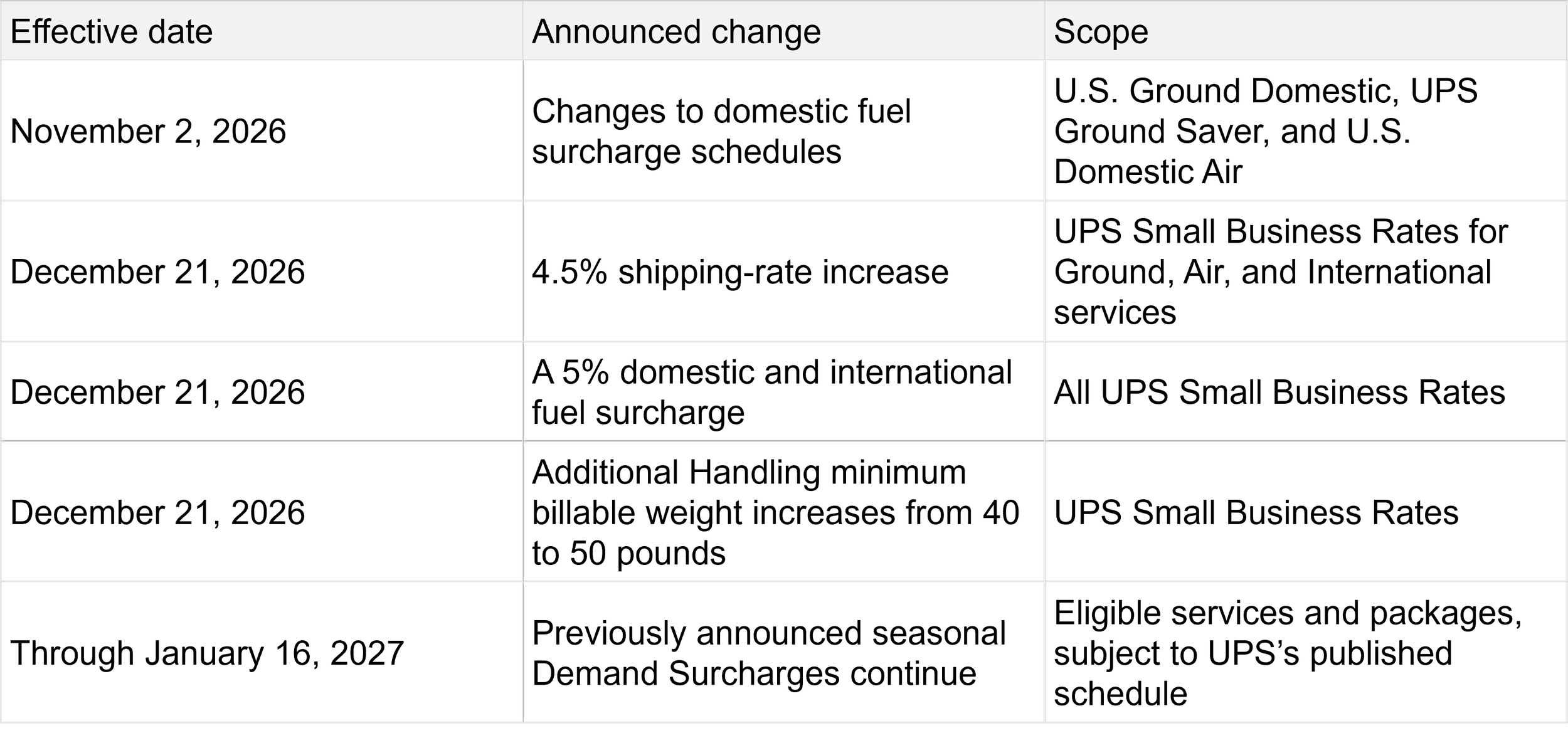
The November fuel changes and December Small Business Rates changes are separate announcements. Seasonal Demand Surcharges are another distinct pricing layer.
An important limitation: the December 4.5% announcement discussed here is specific to UPS Small Business Rates. It should not be presented as a general rate increase for all UPS negotiated accounts. UPS states that more detailed Small Business rate previews will be available later.
1. November fuel changes arrive before the new year
UPS has announced changes effective November 2, 2026, to the fuel surcharge schedules for:
U.S. Ground Domestic
UPS Ground Saver
U.S. Domestic Air
Ground and Ground Saver remain tied to the national average on-highway diesel price. Domestic Air remains tied to the U.S. Gulf Coast jet fuel price. Both continue to adjust weekly. UPS says the changes will be reflected on its fuel surcharge website beginning October 29.
The announcement confirms a schedule change, but the page reviewed does not provide enough detail to quantify a single percentage-point increase for every affected shipment.
That distinction is important. A fuel surcharge can change because the underlying energy index moves, because the carrier changes its pricing schedule, or both. Your analysis should separate those effects rather than attribute every invoice change to fuel-market conditions.
Fuel also applies to more than transportation alone. UPS states that it applies to transportation charges and certain accessorial, value-added, and other charges. An increase in an eligible fee can therefore also increase the fuel dollars associated with that fee.
2. UPS Small Business Rates increase 4.5% on December 21
UPS has announced a 4.5% increase to its Small Business Rates for Ground, Air, and International services, effective December 21, 2026. UPS also notes that the effect on individual shipping costs will vary with shipping characteristics and agreement terms.
For participating shippers, this is a December budget issue, not simply a January planning issue.
The effective date falls during the holiday shipping period. Businesses using this program should account for the change in their remaining 2026 forecast as well as their 2027 budget.
The first step is to confirm whether the account actually uses UPS Small Business Rates. UPS separately describes Daily Rates as applying to customers with scheduled pickup or contracts that provide for Daily Rates. The programs should not be treated as interchangeable.
3. A separate 5% fuel surcharge changes the picture
Alongside the 4.5% rate increase, UPS says a domestic and international fuel surcharge of 5% will apply to all Small Business Rates beginning December 21.
That deserves close attention because the same program page describes its current simplified offering as inclusive of fuel and certain other surcharges. The announced fuel charge changes how participating customers should evaluate the total price.
Looking only at the 4.5% shipping-rate increase would miss that additional component.
An illustrative calculation
Suppose a participating shipment currently has a $100 charge. For illustration only, assume the entire charge increases 4.5%, and the new 5% fuel surcharge then applies to that adjusted amount:

Under those assumptions, the combined increase is approximately 9.73%, not 4.5%.
This is an illustration, not a forecast for every UPS Small Business shipment. The actual result depends on the final rate tables, the charges subject to fuel, shipment characteristics, and agreement terms. It also should not be applied to negotiated Daily Rates accounts as though they received the same announcement.
The lesson is simple: model the combined invoice effect, not just the first percentage in the announcement.
4. Additional Handling minimum billable weight rises to 50 pounds
For UPS Small Business Rates, the minimum billable weight for Additional Handling packages increases from 40 pounds to 50 pounds on December 21, 2026.
This is a billing-weight change. It is not an announcement that the physical-weight threshold for triggering Additional Handling is changing.
That distinction can materially affect the analysis. For a qualifying package that would otherwise rate below the new minimum, the transportation charge may be calculated at a higher billable weight.
The minimum itself rises 25%, but that does not mean the package’s shipping price automatically rises 25%. Transportation rates vary by service, zone, and weight, and some qualifying packages may already have billable weights above 50 pounds.
Shippers should identify:
Packages currently billed at the 40-pound minimum
Additional Handling packages with billable weights below 50 pounds
Products and packaging configurations associated with those shipments
The transportation cost difference under the new minimum
Whether packaging or service changes offer a practical alternative
5. Peak Demand Surcharges overlap with the year-end changes
The previously announced UPS Demand Surcharge schedule continues through January 16, 2027. Its highest holiday charges apply from November 22 through December 26, 2026.
Selected charges during that highest-priced window include:
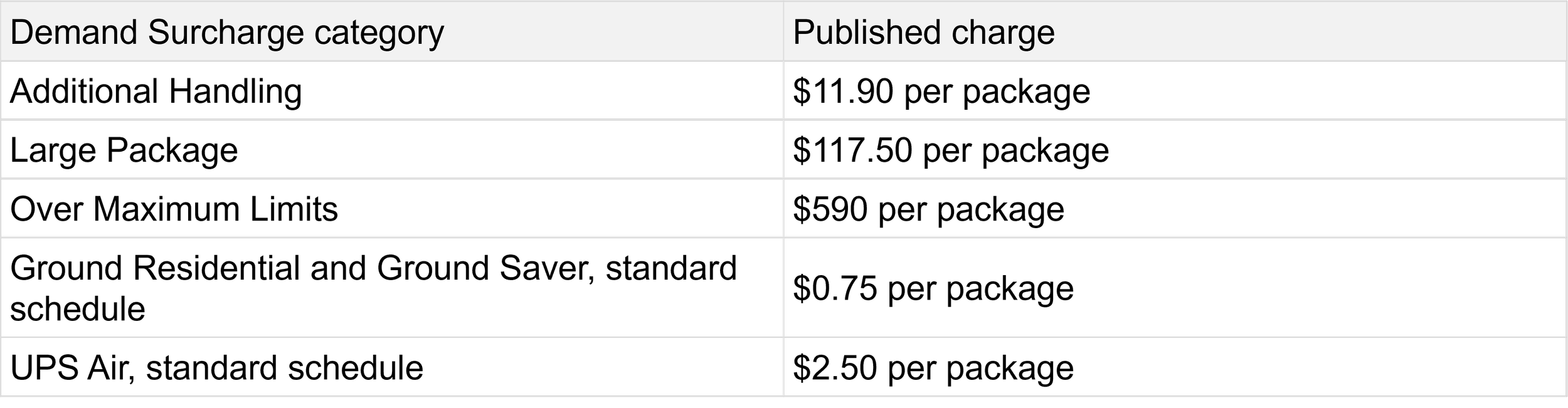
UPS also publishes a separate schedule for qualifying higher-volume customers. These Demand Surcharges apply in addition to other applicable charges, and UPS reserves the right to change amounts or extend demand periods.
Not every charge applies to every account or shipment. The point is to check the overlap rather than assume that one pricing announcement replaces another.
For budgeting, separate temporary peak costs from ongoing rate changes. Otherwise, December invoices can distort your view of the recurring 2027 cost base.
What CFOs and logistics leaders should review now
Confirm the pricing program first
Before applying any announced percentage, establish whether each account uses Small Business Rates, negotiated Daily Rates, Retail Rates, or another arrangement.
A company with multiple accounts should verify each one rather than assume consistent pricing across the organization.
Reprice a representative shipment sample
Use recent invoice and shipment data to examine:
Service and zone
Actual, dimensional, and billed weight
Additional Handling exposure
Fuel-assessable charges
Residential and delivery-area fees
Contract discounts and minimums
Seasonal Demand Surcharges
Compare the same shipment profile under the applicable old and new pricing. Keeping the shipment mix constant helps separate carrier pricing changes from changes in your business.
Build separate year-end and 2027 forecasts
The November 2 and December 21 effective dates mean some changes affect 2026 spending. Demand Surcharges then continue into January under the published schedule.
A useful forecast separates:
Remaining 2026 exposure
Temporary peak-season charges
Recurring 2027 costs
Additional changes that still require final published details
Review contract protection
The relevant question is not simply whether your UPS discount is competitive.
It is whether your agreement addresses the charges that drive your actual spending.
Review fuel provisions, accessorial incentives, minimum-charge treatment, and any applicable billing-weight protections. Identify where published carrier changes flow through and where negotiated terms modify the outcome.
The ShipTrim perspective
For shippers spending $250,000 to $2 million annually on parcel, the challenge is not finding the announcement. It is translating the announcement into a reliable financial forecast and a practical response.
The UPS updates illustrate why that work matters. A shipping-rate increase, a separate fuel surcharge, and a higher minimum billable weight can affect the same pricing program in different ways. Meanwhile, negotiated accounts require their own analysis rather than a percentage borrowed from another program.
ShipTrim provides independent, carrier-agnostic parcel contract assessment, cost analysis, and negotiation advisory. We review shipment data and agreement terms to help clients understand their exposure and identify opportunities to reduce avoidable costs.
Do not wait until the new charges appear on your invoices to determine what they mean.
Let ShipTrim review your UPS year-end and 2027 rate impact
Contact ShipTrim for a free parcel contract assessment. We will review your current pricing structure, evaluate the announced changes that apply to your account, and advise on opportunities to protect your 2027 parcel budget.
